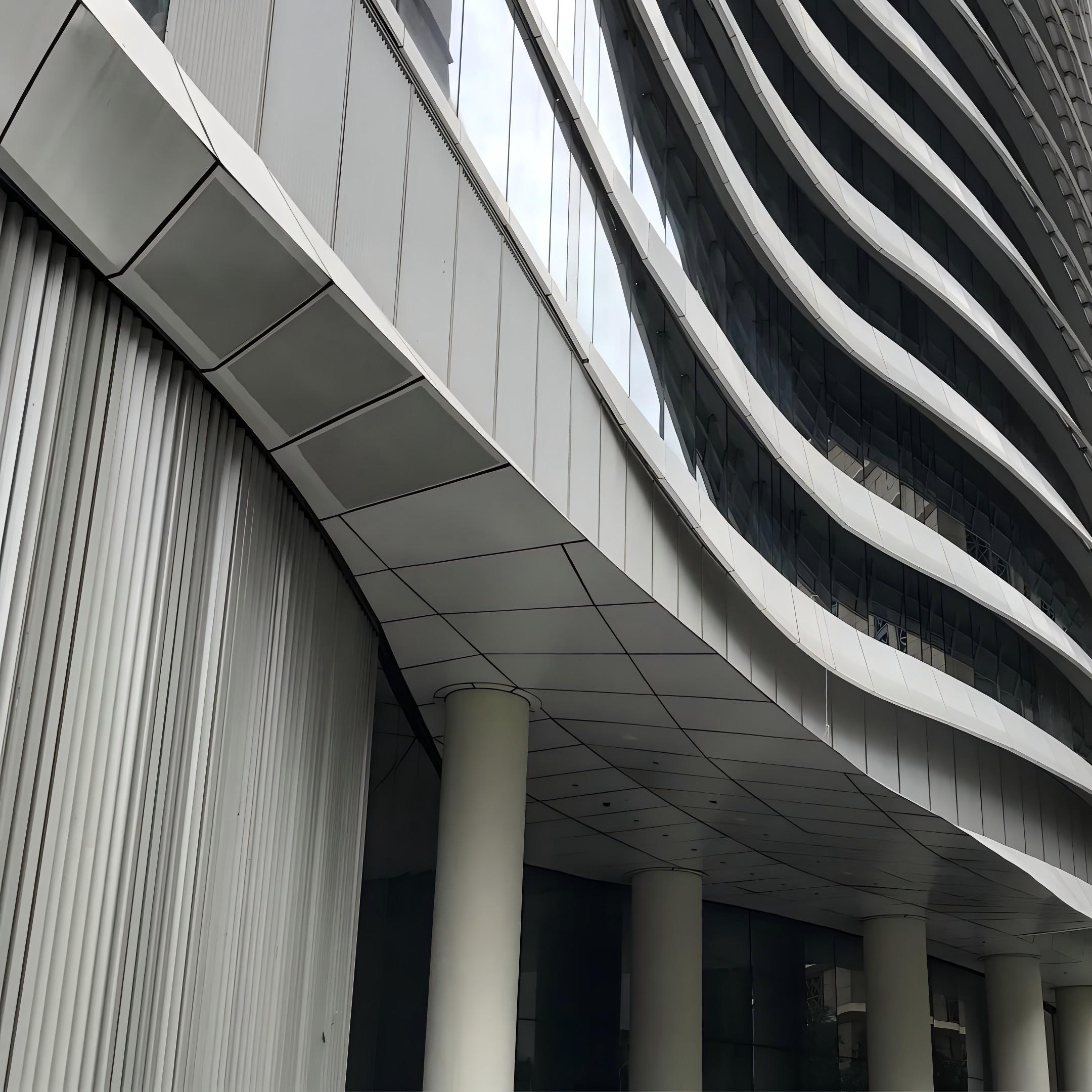
Selecting the appropriate thickness of wood - grained aluminum composite panels requires considering multiple factors. Here are some detailed points:
I. In terms of building applications
Exterior wall decoration
For wood - grained aluminum composite panels used on building exteriors, considering that they need to withstand the long - term influence of natural factors such as wind, sunlight, and rain, as well as possible accidental impacts, it is generally recommended to choose aluminum composite panels with a thickness between 2.5mm and 3.0mm. Thicker panels can provide better structural strength and ensure that they are not easily deformed in complex outdoor environments. For example, in coastal areas, due to frequent strong winds and salt - fog erosion, 3.0mm - thick wood - grained aluminum composite panels can better resist these adverse factors and maintain the flatness and aesthetics of the exterior walls.
Interior decoration
Wall decoration: If it is used for interior walls, the thickness requirements are relatively lower. Generally, a thickness between 2.0mm and 2.5mm can meet the needs. Such a thickness can ensure a certain strength while better adhering to the wall and is convenient for installation. Moreover, the indoor environment is relatively stable and does not require the same high strength as the exterior walls to withstand severe weather. For example, in the living - room wall decoration of an ordinary residence, 2.0mm - thick wood - grained aluminum composite panels can achieve a decorative effect and reduce costs.
Ceiling decoration: When used for interior ceilings, since they mainly bear their own weight and need to consider reducing the load on the top of the building, the thickness can be thinner. Usually, wood - grained aluminum composite panels with a thickness between 1.5mm and 2.0mm are more appropriate. The thinner thickness can reduce the weight and is convenient for installation, and it can also meet the requirements of interior ceilings for decoration and a certain strength. For example, in the interior ceiling of a commercial establishment, 1.5mm - thick wood - grained aluminum composite panels can be installed through a reasonable keel system to show a good decorative effect.
II. In terms of the complexity of the shape
Simple planar shape
If the wood - grained aluminum composite panels are only used for simple planar decoration, such as large - area wall or ceiling plane laying, the thickness can be relatively thin. Generally, a thickness between 1.5mm and 2.0mm can meet the requirements. In this case, the aluminum composite panels mainly play a role in decoration and basic covering and do not need to bear the pressure caused by complex external forces or shape changes.
Complex shapes (curved surfaces, shaped columns, etc.)
When the design involves complex shapes, such as curved walls and shaped columns, in order to ensure that the wood - grained aluminum composite panels can be smoothly processed into the required shapes and maintain the stability of the shapes, a thicker thickness needs to be selected. A thickness between 2.5mm and 3.0mm is recommended. Because when processing these complex shapes, the aluminum composite panels need to undergo bending, stretching and other processes, and thicker panels can better withstand the stresses in these processing procedures and avoid cracking or deformation. For example, in the decoration of the curved entrance of a large shopping mall, using 2.5mm - thick wood - grained aluminum composite panels can better shape a smooth curve and maintain the shape unchanged during long - term use.
III. In terms of cost - budgeting
Economic considerations
Thinner wood - grained aluminum composite panels have a relatively lower price. If the budget is limited, a thinner thickness can be selected to control costs on the premise of meeting the basic usage requirements. For example, for some small - scale indoor projects with relatively good - using environments and not particularly high requirements for decorative effects, such as the wall decoration of a small office, 1.5mm - thick wood - grained aluminum composite panels may be an economical choice.
Quality - cost balance
However, you should not choose an overly thin thickness just to reduce costs. It is necessary to comprehensively consider quality and service life. Thicker aluminum composite panels may have more advantages in terms of strength and durability, etc. In the long run, they may reduce the costs of replacement and maintenance. For example, in the exterior wall decoration of some high - end buildings, although the initial cost of 2.5mm - 3.0mm - thick wood - grained aluminum composite panels is higher, due to their better weather resistance and structural stability, they can be used for a longer time and the comprehensive cost may be lower instead.
The thickness tolerance range of wood - grained aluminum composite panels is generally determined according to national standards and industry practices. Here are the common thickness tolerance ranges:
Wood - grained aluminum composite panels for outdoor use
When the nominal thickness is not less than 2.0mm, the thickness tolerance is generally ±0.2mm.
Wood - grained aluminum composite panels for indoor use
When the thickness is relatively thin, such as 1.0 - 1.2mm, the tolerance range is usually about ±0.1mm.
When the thickness is between 1.2mm and 1.5mm, the tolerance is generally ±0.15mm.
When the thickness is between 1.5mm and 3.0mm, the tolerance range is approximately ±0.2mm.