Unlocking Architectural Aesthetics: The Diverse Applications of Aluminum Veneer in Modern Architectural Design
I. Introduction to Aluminum Veneer
Aluminum veneer refers to a building decorative material that is processed through treatments such as chromizing and then using fluorocarbon spraying technology. It possesses numerous advantages such as being lightweight, having high strength, and excellent rigidity. The lightweight feature makes the installation process relatively easy and can effectively reduce the load on the building. Meanwhile, its relatively high strength and rigidity ensure that it is not prone to deformation during long-term use, maintaining the stability of the building's exterior appearance.
II. Applications on the Building Facade
Shape Creation
Aluminum veneer can be fabricated into various complex geometric shapes through processes such as cutting, bending, and welding. For example, some modern buildings pursue unique streamlined exteriors, and aluminum veneer can fulfill this design intention well. Take the Guangzhou Opera House as an example. Its facade resembles two huge rocks that have been eroded by the Pearl River water. The irregular curved shape of its exterior was accomplished by utilizing the moldability of aluminum veneer. By processing the aluminum veneer into curved surfaces that meet the design requirements and then assembling and installing them, an extremely artistic architectural image was created.
For some futuristic buildings, designers can use aluminum veneer to create various three-dimensional shapes, such as cantilevered structures and wavy facades. These shapes not only enhance the visual impact of the building but also reflect its individuality and innovation.
Color Expression
Aluminum veneer has significant advantages in terms of color. It can present a variety of colors through processes such as fluorocarbon spraying, and the color durability is high. Architectural designers can select appropriate colors according to the function of the building, its surrounding environment, and the design concept. For example, in commercial buildings, bright and vivid colors such as red and yellow are often used to attract customers' attention; while in cultural buildings or office buildings, relatively calm tones such as silver-gray and dark-gray may be adopted.
In addition, aluminum veneer can also increase the layering of the building facade through two-tone processing or gradient color processing. For instance, on the facades of some high-rise buildings, a color gradient from dark to light is used from the bottom to the top, creating a sense of upward dynamism through the color changes of the aluminum veneer.
Curtain Wall System
The aluminum veneer curtain wall is one of the commonly used curtain wall forms in modern buildings. It has good sealing and waterproof properties. In some high-rise buildings, the aluminum veneer curtain wall can effectively resist the invasion of wind and rain. Its installation methods are also relatively flexible, including open-type, unit-type and other installation systems. The open-type aluminum veneer curtain wall system can achieve good ventilation effects and is suitable for buildings with high requirements for indoor air quality, such as hospitals and office buildings. The unit-type aluminum veneer curtain wall has the characteristics of fast installation speed and high precision and is suitable for large-scale building curtain wall projects.
III. Applications in Interior Decoration
Ceiling Decoration
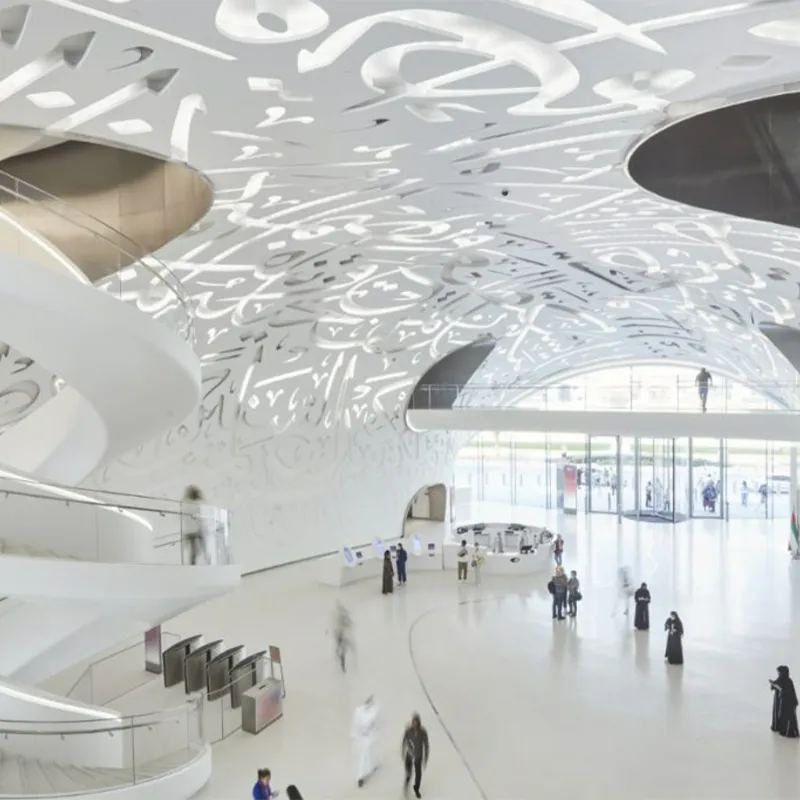
When used for ceiling decoration, aluminum veneer can create a flat and concise effect. Its surface can be perforated to form various patterns. For example, in the lobbies of some large shopping malls or hotels, by perforating the aluminum veneer ceiling to create starry sky patterns or geometric patterns and coordinating with the lighting system, a romantic or fashionable atmosphere can be created.
Moreover, the fireproof performance of the aluminum veneer ceiling is good. In some places with high requirements for fire prevention, such as the dining areas of shopping centers and cinemas, using aluminum veneer ceiling can effectively improve the fire safety level of the building.
Wall Decoration
In terms of interior wall decoration, aluminum veneer can imitate the appearance of various materials. It can present the textures of different materials such as wood and stone through surface treatment processes such as wood grain transfer printing and stone grain transfer printing. In this way, in some situations where cost control or weight limitations are required, aluminum veneer can be used to replace real wood or stone. For example, in the guest rooms of some budget hotels, using aluminum veneer to imitate wooden walls can achieve a similar decorative effect while reducing costs and lightening the building load.
The aluminum veneer wall can also be used for zoning decoration. By combining aluminum veneer of different colors, shapes or patterns, the indoor space can be divided into different functional areas. For example, in an open-plan office, colored aluminum veneer can be used to divide the office area, the leisure area and the meeting area.
IV. Applications in Architectural Detail Decoration
Eave and Waistline Decoration
Aluminum veneer can play a good decorative role in the eave and waistline parts of the building. At the eave, it can increase the layering and three-dimensional sense of the building through shape design, such as making it into the shape of dougong in classical architecture or a modern broken line shape. The use of aluminum veneer in the waistline part can highlight the horizontal lines of the building through color or material contrast, making the building look more stable.
Door and Window Frame Decoration
For the decoration of door and window frames, aluminum veneer can provide delicate borders. It can be customized according to the style of the door and window. For example, the aluminum veneer for European-style door and window frames can be made into a pattern with carved flowers, while the modern and simple style door and window frames can adopt a concise line shape. The aluminum veneer door and window frames not only have decorative properties but also can protect the edges of the door and window from collision damage.